Tel. : 450.983.4233 - Contact Us
Free Consultation
Lingual Orthodontics
History of lingual orthodontics
3 Columns
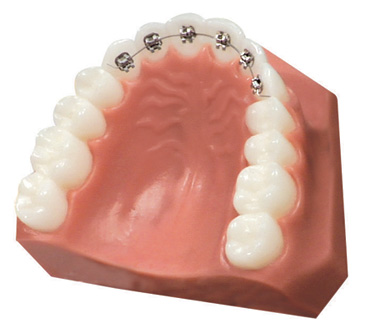
Modern lingual orthodontics is a special technique pioneered in the 70s, under the leadership of Dr. Fujita (Japan) and Dr. Kurtz (USA). The word lingual is used to describe the positioning of orthodontic brackets on the inner side of the teeth, that is to say on the side of the tongue. This is a treatment technique which uses the same principles as conventional techniques where the braces are positioned on the external face of the teeth (labial or buccal).
Traditionnaly, lingual orthodontics was a very difficult modality to execute, it thus motivated active and successful clinical research. We are now combining advanced technological modeling and softwares to help us position or even design braces and wires that are completely individualized with a much higher precision than direct manual positioning of braces.
Are there any contra-indications for lingual orthodontics?
Yes and no: the contra-indications are those related to orthodontics in general. Those specific to lingual positioning are very limited: some teeth have a morphology that can makeit very difficult to properly position a lingual bracket. Lingual braces can also modify speech, particularly early in treatment (usually the first two weeks). Recent technological advances made on the shape and design made on these braces make for treatments that are very bearable. Patients with visible braces have in many cases shown the desire to prematurely remove their braces, sometimes at the expense of proper finishing procedures to ensure a perfect bite; whereas patients treated with lingual braces that are not visible have a level requirement that is assertive and prefer to keep the braces on a few more months to ensure the best result.
We have noticed that during treatment , The lingual appliance is well integrated and much less annoying than in the first two weeks of the treatment
Can we expect to be treated as well with lingual brackets than with regular braces?
Without hesitation yes, some situations are even easier to handle in lingual braces than in the vestibular approach; lingual orthodontics is a tool that offers the same control of dental movements that we have with conventional braces.This technique allows the treatment of minor dental alignments, complex cases requiring permanent tooth extraction (Fig. 1) as complex cases combining jaw surgery and orthodontics (Fig. 2).

Fig. 1: Before treatment - During treatment - after treatment

Fig. 2
Is there a fee difference between lingual braces and regular braces?
Yes, the difference in fees is due to two important and specific facts: a lingual appliance is between 3 and 4 times more expensive than the visible braces, and the appointments average duration on the dental chair is at least 2 times longer for Lingual Treatment.
it is important to note that the total duration of the treatment stays the same ( a 18 month treatment for example is done in 18 months with a lingual or a conventional approach).
These two points alone justify a different fee. To this we can add that further training is required before an orthodontist is certified to provide lingual treatment has his office. Dr Benguira is certified in lingual orthodontics with the Incognito technique ( www.hiddenbraces.com ) And eHarmony ® ( www.myharmonysmile.com).
The lingual orthodontics is a promising technique. It is aimed both adolescents and adults . It allows our patients to live better their orthodontic treatment .
Multidisciplinary collaboration between different specialties of dentistry (periodontics, implantology, prosthodontics ...) is increasingly calling for orthodontics and our adult patients love the option of a bracefree smile while they are in treatment!